.png)
Instructions for deploying the Thales CTM Connector to scan for cryptographic assets and deliver findings to the AgileSec Platform for processing and analysis.
Overview
The Thales CTM Connector integrates Thales CipherTrust Manager with Keyfactor's AgileSec Platform. This Connector allows discovery, inventory, and analysis of cryptographic keys managed by a Thales CipherTrust Manager instance.
What Gets Scanned
The Thales CTM Connector can discover the following cryptographic asset types:
-
Cryptographic Keys: All symmetric and asymmetric cryptographic keys managed by CipherTrust Manager.
-
Key Metadata: Key attributes, algorithms, sizes, states, usage operations, labels, aliases, and fingerprints.
-
Public Key Material: RSA, DSA, and ECDSA public key components for asymmetric keys.
Prerequisites
Ensure you meet the following requirements to enable scanning.
Network Access
Ensure HTTPS network connectivity from AgileSec platform or remote execution machine to the CipherTrust Manager server.
Supported Authentication Methods
The Thales CTM Connector supports two authentication methods:
1. All Execution Methods: Basic Authentication (Username and Password)
Standard username/password authentication against the CipherTrust Manager is available for Platform, API, and Remote Scan Executions.
-
Configure
username,password,domain, and optionallyauth_domainfields -
domaindefaults torootif not specified
2. Remote Scan Execution Only: mTLS Certificate Authentication
MTLS (certificate-based) authentication is available for Remote Scan Execution only:
-
Requires a
client_id(obtained during client registration) -
Requires
client_certificateandclient_private_keyfile paths -
Optionally specify
root_cato verify the CipherTrust Manager server certificate
There are two methods to setup mTLS authentication for the Thales CTM Connector:
-
Using a Local CA from Thales CTM
-
Using an External CA
init.sh
The init.sh script is provided below to gather the configuration parameters required for mTLS authentication. This script is not required; other methods may be used to create the authentication client and certificate materials.
The script will output the client_id, client_certificate path, client_private_key path, and root_ca.
2.1 Using Local CA from Thales CTM
2.2 Using External CA
Thales CTM Required Access Rights
The authenticated user must have the following permissions:
|
Permission |
Purpose |
|---|---|
|
|
Query Keys from |
Remote Execution Requirements
If running the Connector remotely using CLI, the remote execution machine must meet these requirements:
|
Component |
Requirement |
|---|---|
|
Operating System |
|
|
RAM |
Minimum 500 mb (0.5 GB) to enable API calls and data streaming. |
|
Disk Space |
Minimal; scans are API-driven and findings are streamed to the AgileSec platform. No data is stored on disk. |
|
Permissions |
Read/write access to remote sensor working directory (remote sensor install location) |
Running the Connector
AgileSec Thales CTM scans can be executed using the following methods:
-
Platform Scan Execution: Configure and execute scans directly through the Keyfactor AgileSec web UI with on-demand or scheduled execution options.
-
API Scan Execution: Programmatically trigger scans through REST API calls, enabling integration with CI/CD pipelines and automation workflows.
-
Remote Scan Execution: Deploy and run the connector via CLI on customer-managed infrastructure for scenarios such as:
-
Scanning air-gapped or internal instances the platform cannot directly reach
-
Customers wanting to manage their own scheduling and execution environment.
-
Refer to Scan Execution Flows for additional scan execution information.
Connectors/Sensors Note: Connectors are considered a subset of Sensors. Sensors and Connectors utilize the same Unified Sensor Framework, but Sensors use the Host Sensor for additional scanning depth.
“Sensor”-labeled variables for API and Remote execution are common to both Sensors and Connectors. Unless specified, do NOT update these with “Connector”.
Configuration Fields
The following parameters are used to configure AgileSec Thales CTM scans.
|
Field Name |
UI Display Name |
Type |
Required |
Description |
|---|---|---|---|---|
|
|
CipherTrust URL |
String |
✅ Yes |
The base URL of the CipherTrust Manager instance |
|
|
Username |
String |
✅ Yes if using password auth |
Username for password authentication |
|
|
Password |
String |
✅ Yes if using password auth |
Password for password authentication |
|
|
Domain |
String |
❌ No |
CipherTrust Manager connection domain. Default: |
|
|
Auth Domain |
String |
❌ No |
Authentication domain, if different from |
Remote and API Scan Execution Parameters
In addition to the above, the following parameters are available for remote and API scan executions only.
|
Field Name |
Type |
Required |
Description |
|---|---|---|---|
|
|
String |
✅ Yes if using mTLS auth |
Client ID for mTLS authentication (obtained from |
|
|
String |
✅ Yes if using mTLS auth |
Path to client certificate for mTLS authentication. |
|
|
String |
✅ Yes if using mTLS auth |
Path to client private key for mTLS authentication. |
|
|
Number |
❌ No |
Number of results per API page for pagination of large key inventories. Defaults to 1000. |
|
|
String |
❌ No |
REMOTE EXECUTION ONLY. NOT AVAILABLE FOR API SCANS. Path to root CA certificate file. If not specified, certificate verification is disabled. |
Platform Scan Execution
Running scans through the user interface is the simplest and fastest way to get started. The platform enables running on-demand or scheduled scans in a dedicated environment.
Platform Scan Configuration
-
Open your browser and navigate to the Keyfactor AgileSec Platform Web URL
-
Log in with your credentials
-
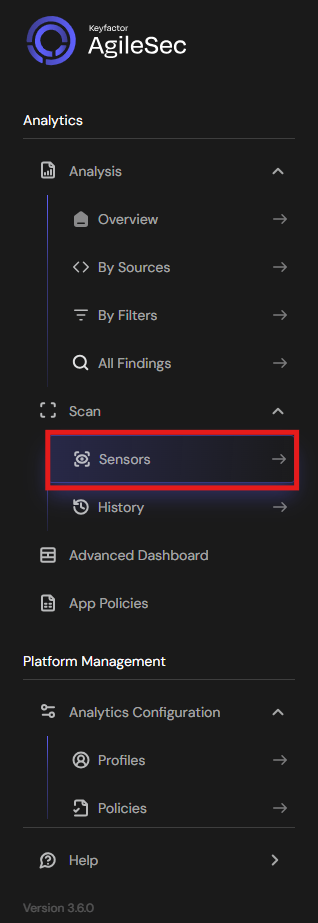
Click on "Sensors" in the left navigation menu under Scan
-
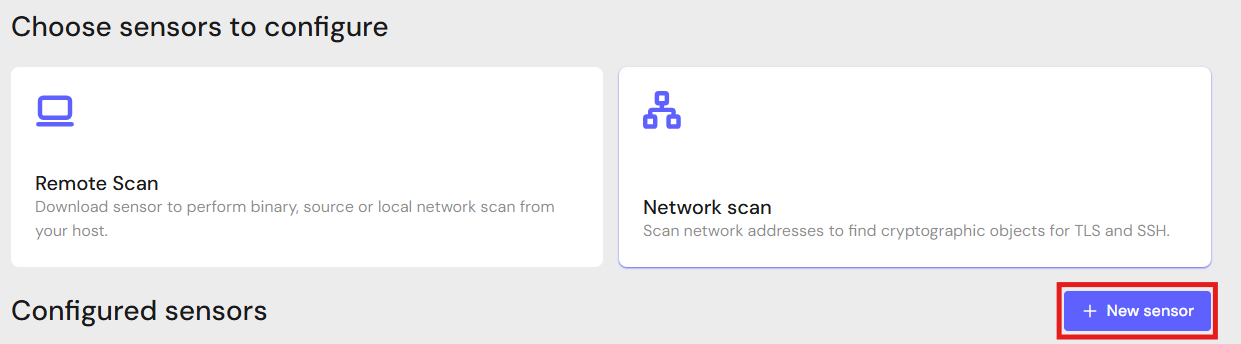
Click "+ New Sensor".
-
Click on the correct card to open the configuration interface.
Configure Parameters and Start Scan
-
Fill in the required configuration parameters.
-
Click Save.
-
Click Action then Scan to begin a scan.
Note: Click Edit to reconfigure parameters.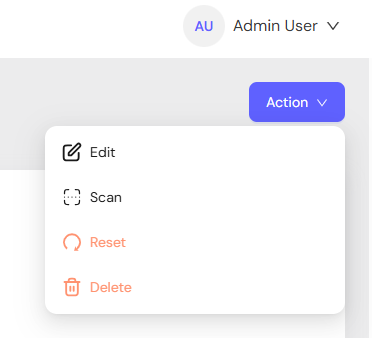
API Scan Execution
Scans may be programmatically triggered through REST API calls, enabling seamless integration with CI/CD pipelines, automation workflows, and custom applications. API execution provides flexibility for developers to incorporate cryptographic scanning into their existing development and deployment processes.
Note: For complete API reference, see API.
Generate AgileSec API Access Token
-
Open your browser and navigate to AgileSec Platform UI
-
Log in with your Keyfactor credentials
-
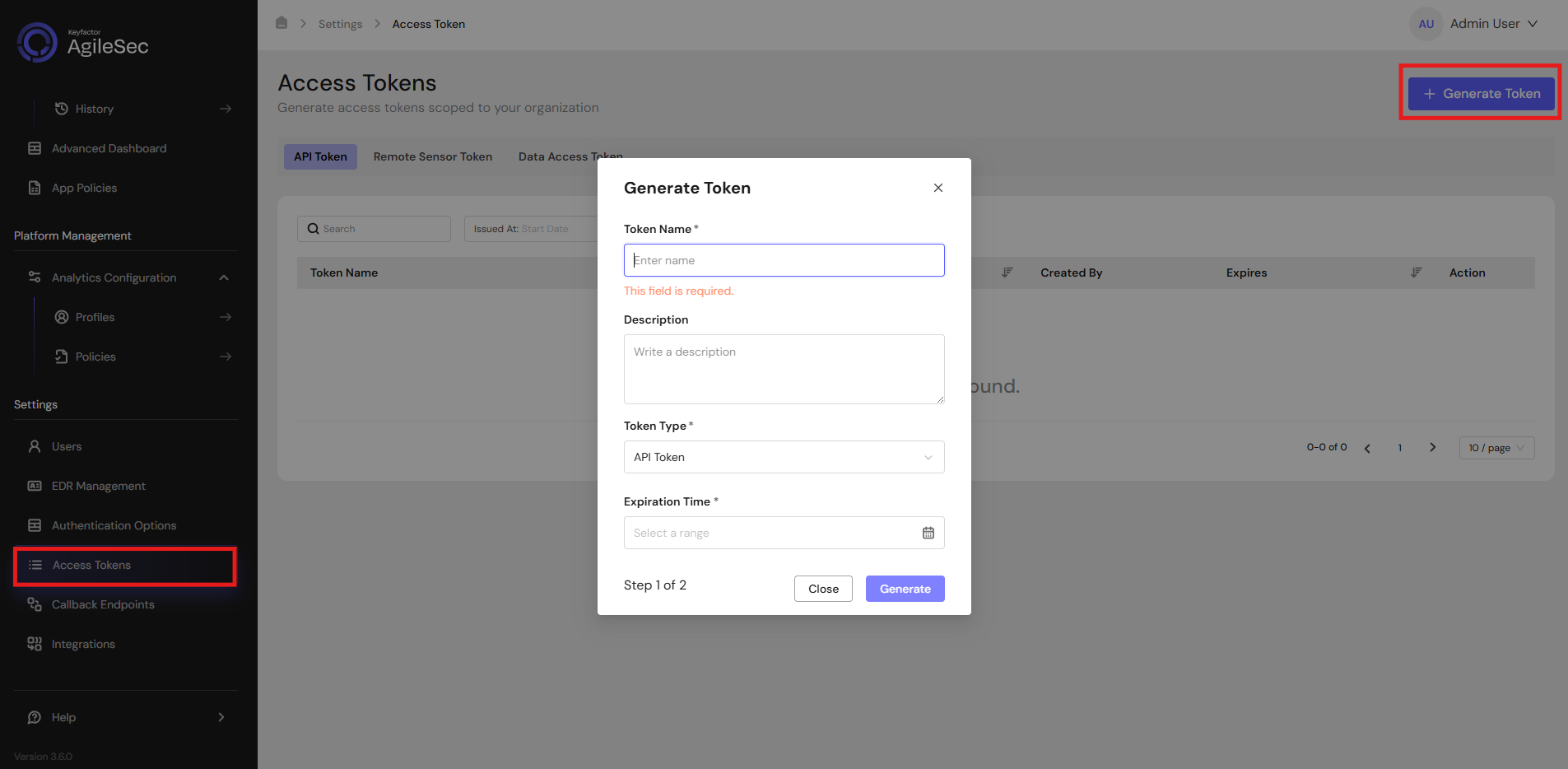
Click "Access Tokens" in the main navigation menu
-
Click "Generate Token" button
-
Set Token Type to API Token and provide the required details
-
Click "Generate" and copy the generated token
AgileSec API Endpoint
POST https://<platform-url>/v3/scan/create/
Request Format
Headers
Content-Type: application/json
isg-api-token: <your-api-token>
Request Body
  {
    "sensorName": "<sensor name>",
    "sensorType": "Thales CTM",
    "sensorConfig": {
       "base_url": "<ciphertrust manager url>",
       "username": "<username>",
       "password": "<password>",
       "domain": "root",
       "auth_domain": "root"
    },
    "callbackId": "<callback id>",
    "labels": [
        {
            "<label name>": "<label value>"
        }
    ],
    "priority": "<priority>"
  }
Remote Scan Execution
Scans may be run on remote host machines with the AgileSec Remote Sensor Package.
Download Remote Sensor Package
-
Open your browser and navigate to the Keyfactor AgileSec Platform Web URL
-
Log in with your credentials
-
Click on "Sensors" in the left navigation menu under Scan
-
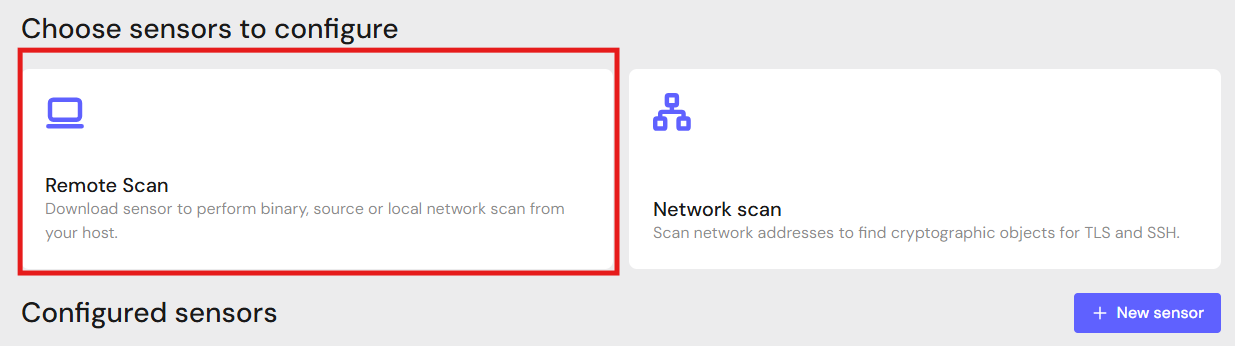
Click Remote Scan.
-
Click + Download Remote Sensor.

-
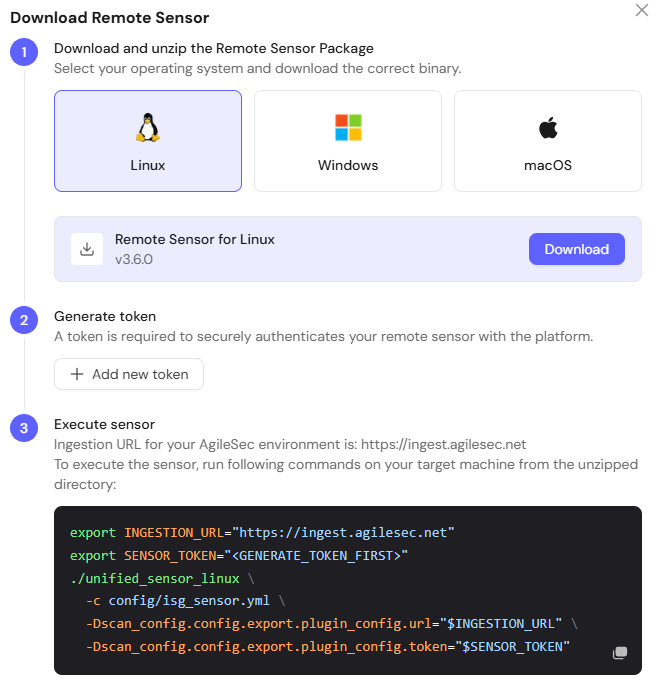
Download the sensor binary for your remote machine’s operating system
Generate Platform Token
-
In the Download Remote UI, click "Generate Token"
-
Copy the generated token
-
Store securely in an environment variable such as
SENSOR_TOKEN:export SENSOR_TOKEN="your-generated-token"
Create Configuration File
Create a YAML configuration file (e.g., thales_ctm-config.yml) with your scan settings. An example configuration can be found in config/sample-configs/thales_ctm.yml.
Step 4: Run the Connector
Execute the Connector with your configuration file:
-
Linux/macOS
Bash# Set environment variables export SENSOR_TOKEN="your-sensor-token" # Run Connector ./unified_sensor_linux -c thales_ctm-config.yml -
Windows (PowerShell)
PowerShell# Set environment variables $env:SENSOR_TOKEN = "your-sensor-token" # Run Connector .\\unified_sensor_windows.exe -c .\\thales_ctm-config.yml
Remote Scan Execution Configuration Examples
-
Username/Password Auth Example
YAMLscan_config: plugins: - thales_ctm - export config: thales_ctm: name: thales plugin_config: base_url: "<https://ciphertrust.company.com>" username: "${env:CTM_USER}" password: "${env:CTM_PASS}" domain: "root" # auth_domain: "" # client_id: "" # client_certificate: "/path/to/cert.pem" # client_private_key: "/path/to/privateKey.pem" # root_ca: "/path/to/rootca.pem" # interval: 60 # page_limit: 100 -
mTLS Auth Example
YAMLscan_config: plugins: - thales_ctm - export config: thales_ctm: name: thales plugin_config: base_url: "<https://ciphertrust.company.com>" client_id: "3ec05d42-72f0-45aa-8196-f17d73a2f9f0" client_certificate: "/path/to/cert.pem" client_private_key: "/path/to/privateKey.pem" root_ca: "/path/to/rootca.pem" # auth_domain: "" # root_ca: "/path/to/rootca.pem" # interval: 60 # page_limit: 100
Known Limitations
Authentication
mTLS authentication requires certificate and key files accessible at the specified paths on the machine running the Connector.
Pagination
Very large key inventories may require tuning the page_limit setting for optimal performance.
Troubleshooting Common Errors
-
CONFIG-404– Unable to read/parse configuration file-
Cause: The configuration file path is incorrect or the file is malformed.
-
Fix: Verify the config file path and validate JSON syntax.
-
-
CONFIG-500– No Thales CTM scan target defined-
Cause: A required configuration field is missing.
-
Fix: Ensure
base_urlis provided.
-
-
Authorization Error-
Cause: Invalid credentials, expired certificate, or incorrect
client_id. -
Fix: Verify credentials or regenerate client certificate. Check
domainandauth_domainsettings.
-
-
No Thales CTM scan target defined-
Cause:
base_urlis empty. -
Fix: Set the
base_urlto the CipherTrust Manager URL.
-
Getting Support
Collect diagnostic information:
-
Connector version
-
Configuration file (redact credentials and keys)
-
Log output
-
CipherTrust Manager details (URL, version)
Contact Support
-
Portal: https://support.keyfactor.com