.png)
Externalizing your OCSP service to a Validation Authority provides several benefits:
-
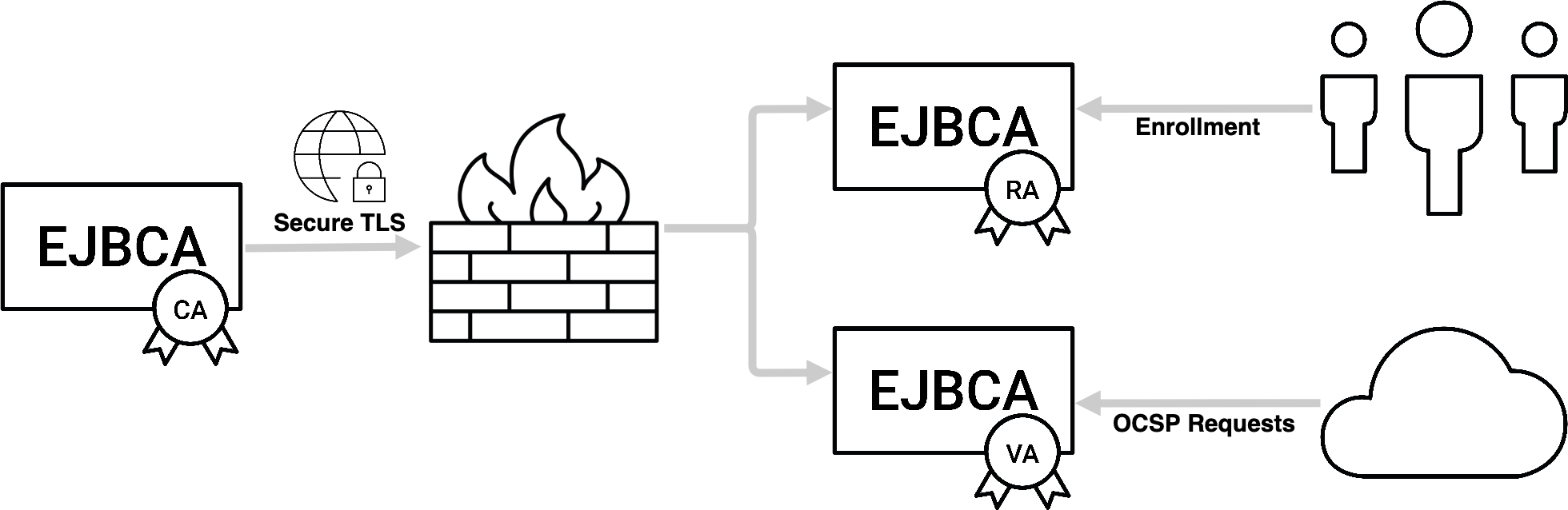
By separating the validation service from the CA, security is increased by allowing the CA to reside behind a firewall not allowing incoming connections, while the VA(s) reside in the DMZ.
-
Externalization of the VA allows for greater degrees of availability. Separation allows for maintenance to be performed on even unclustered CAs without any downtime on OCSP services.
-
Ensure the highest performance. Even though the OCSP responder is fast, it's not uncommon for loads on a VA infrastructure to be extremely high at times. Several VA nodes can set up to proxy for the same CA behind a load balancer, and VA nodes can be localized geographically to ensure minimal RTT.
The following shows a rough schema of the architecture using external OCSP responders.
Features
-
Independent of CA software used (various degrees of integration possible and may be required).
-
One responder can respond for any number of CAs.
-
Status information stored in SQL database.
-
Not depending on CRLs. Status information can be updated in real-time.
-
Plug-in mechanism for custom OCSP extensions.
-
Highly configurable audit and transaction logging. Suitable for invoicing.
-
Supports PKCS#11 HSMs and soft keys.
-
Built-in health check used by load balancers and for monitoring.
-
Configurable for requiring signed requests, authorized signers, etc.
-
Can answer good or unknown to non-existing certificates, with different configuration based on request URI.
-
Linear scalability for performance and high availability by adding multiple nodes.
-
High performance, >500 requests per second on a single server.
-
On-line renewal of OCSP responder keys and certificates.
-
OCSP client in Java (Client ToolBox).
-
Support for Norwegian Unid FNR extension.
-
Support for German CertificateHash extension.